Table of Contents
- Introduction
- How IELTS Band Score Is Calculated
- IELTS Score Chart
- IELTS Band Score Chart and Marking Criteria for Each Section
- IELTS Reading Band Scores and Their Meaning
- IELTS Writing Band Score and Marking Criteria
- IELTS Speaking Band Score and Marking Criteria
- IELTS Requirements for New York University (NYU): Undergraduate & Graduate
- Standardized Tests Accepted for Graduate Admissions
- Scholarships at New York University
- Key Takeaways
- FAQs
Introduction
The IELTS band score is the key measure of your English proficiency and plays a crucial role in admissions, visas, and job applications. It reflects your performance across the four test components: Listening, Reading, Writing, and Speaking. Understanding how the band score is calculated, what each band represents, and how to interpret your scores can help you plan your preparation effectively and achieve your desired results. In this blog, we break down the scoring system, section-wise marking criteria, and provide tips to improve your overall band score.
How IELTS Band Score Is Calculated
The IELTS exam uses a band scale from 0 to 9. Each section—Listening, Reading, Writing, and Speaking—is scored separately. The overall IELTS band score is the average of these four scores, which is then rounded to the nearest whole or half band.
For example:
- If your average score is 7.25, it will be rounded to 7.5.
- If the average is 7.75, it will be rounded to 8.0.
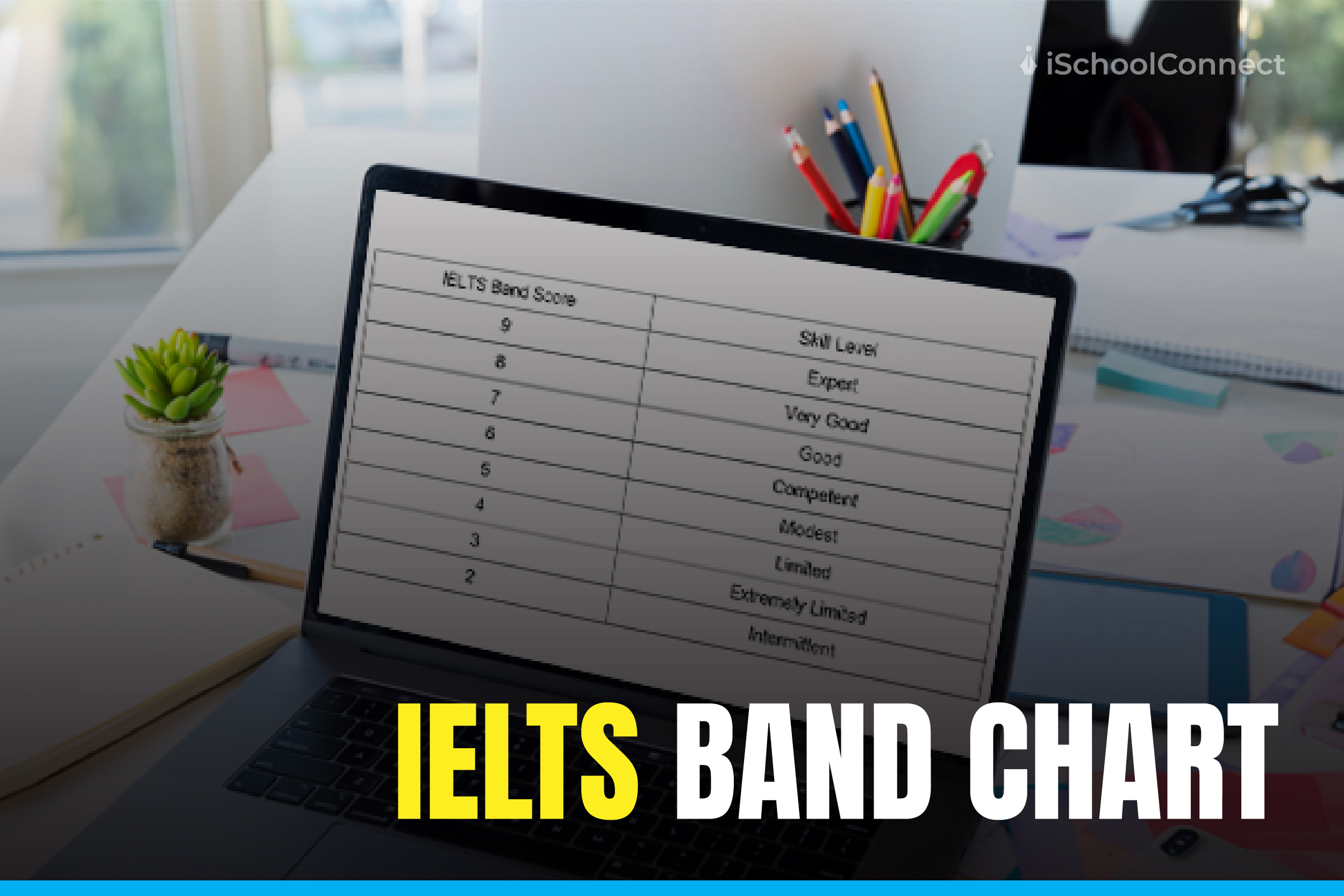
Below is the IELTS Band Score chart that applies to both Academic and General Training tests.
IELTS Score Chart
| Band Score | Skill Level | Meaning |
| Band 9 | Expert | Full command of the language with accurate, fluent, and appropriate English. Demonstrates complete understanding. |
| Band 8 | Very Good | Strong command of the language with only occasional errors. May misunderstand unfamiliar situations but handles complex details well. |
| Band 7 | Good | Operational command with some inaccuracies or misunderstandings. Generally able to handle complex language. |
| Band 6 | Competent | Effective command despite some errors. Can understand and use fairly complex language, especially in familiar situations. |
| Band 5 | Modest | Partial command of English. Can understand overall meaning but makes frequent mistakes. Able to manage basic communication. |
| Band 4 | Limited | Basic competence limited to familiar situations. Frequent problems with understanding and expression. |
| Band 3 | Extremely Limited | Conveys and understands only general meaning in very familiar contexts. Communication often breaks down. |
| Band 2 | Intermittent | Has great difficulty understanding spoken and written English. |
| Band 1 | Non-user | Can use only a few isolated words; no real communication ability. |
| Band 0 | Did Not Attempt the Test | No responses provided. |
Read More: Best Books for IELTS Preparation
IELTS Band Score Chart and Marking Criteria for Each Section
The IELTS test is scored on a 9-band scale, and each section—Listening, Reading, Writing, and Speaking—has its own marking criteria. Below is a clear breakdown of how scores are calculated in each module and what examiners look for.
IELTS Listening & Reading: Band Scores and Evaluation
How Listening and Reading Are Scored
- Both sections contain 40 questions.
- Every correct answer = 1 mark.
- The total raw score (out of 40) is converted to a band score using a standardised conversion chart.
- Final scores are reported in whole or half bands (e.g., 6.0, 6.5, 7.0).
IELTS Listening Band Scores and Their Meaning
Here is the approximate raw-score to band-score conversion for Listening. The exact number may vary slightly depending on the test version.
| Correct Answers (out of 40) | Listening Band Score |
| 40 | 9 |
| 35 | 8 |
| 30 | 7 |
| 23 | 6 |
| 16 | 5 |
How to Calculate Your IELTS Listening Score
Your number of correct answers (raw score) is matched with the official conversion chart to determine your final Listening band score.
IELTS Reading Band Scores and Their Meaning
The Reading section also has 40 questions, with each correct response worth 1 mark.
Both Academic and General Training tests use the same 9-band scale, but the difficulty level differs:
- Academic Reading contains more complex texts.
- General Training Reading usually requires more correct answers to achieve the same band score.
Academic Reading Conversion Chart
| Correct Answers (out of 40) | Academic Reading Band Score |
| 40 | 9 |
| 35 | 8 |
| 30 | 7 |
| 23 | 6 |
| 15 | 5 |
General Training Reading Conversion Chart
| Correct Answers (out of 40) | General Training Band Score |
| 35 | 7 |
| 30 | 6 |
| 23 | 5 |
| 15 | 4 |
How to Calculate Your IELTS Reading Score
Match your raw score with the conversion table for Academic or General Training to find your final band score.
IELTS Writing Band Score and Marking Criteria
Writing is assessed by trained IELTS examiners based on four equally weighted criteria:
Writing Assessment Criteria
- Task Achievement (Task 1) / Task Response (Task 2)
- Coherence and Cohesion
- Lexical Resource (Vocabulary)
- Grammatical Range and Accuracy
Each task is scored separately, then averaged to give your final Writing band score.
Note: Task 2 carries more weight than Task 1.
IELTS Speaking Band Score and Marking Criteria
Speaking is evaluated through a face-to-face or video-call interview. Examiners assess your performance using four equally weighted criteria:
Speaking Assessment Criteria
- Fluency and Coherence
- Lexical Resource
- Grammatical Range and Accuracy
- Pronunciation
Your Speaking band score is the average of these four criterion scores.
Read More: IELTS General Training Practice Test: Why is it Important?
IELTS Requirements for New York University (NYU): Undergraduate & Graduate
For Undergraduate Admissions (UG)
For undergraduate admissions at New York University, applicants are expected to demonstrate strong English proficiency. NYU now typically looks for an IELTS Academic score of 7.5 and above, ensuring that students can perform well in an English-medium academic environment.
A band score of 7.5+ reflects a high level of proficiency across all four language skills—Listening, Reading, Writing, and Speaking—showing that students can handle complex course material, participate actively in discussions, and complete academic writing tasks successfully.
Requirement (UG):
-
- Minimum IELTS Academic Score: 7.5 and above
- No individual band below: 7.0 (recommended for competitiveness)
- This guarantees well-balanced proficiency in all language areas.
- Minimum IELTS Academic Score: 7.5 and above
Postgraduate (PG) IELTS Requirement at New York University
For graduate admissions, NYU expects applicants to meet advanced English language standards due to the academic rigor of master’s and doctoral programs. Most programs now look for an IELTS Academic score of 7.5 and above to ensure students can understand advanced material, engage in research, and produce high-level academic writing.
Since requirements may differ slightly across departments, some specialised programs (like Business, Law, Public Policy, or Technical fields) may require even higher scores. However, 7.5+ is considered the standard benchmark for strong applications.
-
- Minimum IELTS Academic Score: 7.5 and above
- No individual band below: 7.0 (recommended for most graduate programs)
- Always check the specific program page, as highly competitive fields may set higher benchmarks.
Erudition at New York University
New York University (NYU) requires applicants to demonstrate strong English proficiency through standardized tests such as the IELTS Academic. Students who do not meet the required IELTS score can benefit from NYU’s English language support programs, which are designed to help them improve their language skills and eventually meet the university’s admission standards. In some cases, applicants may need to complete additional language courses and retake the IELTS exam to qualify for their chosen program.
Standardized Tests Accepted for Graduate Admissions
To provide flexibility for diverse academic backgrounds, NYU accepts various standardized test scores for graduate admissions, depending on the program requirements. These include:
- GRE
- GMAT
- MCAT
- LSAT
- DAT
Each graduate school or department may have specific score expectations, so applicants should review their program’s test requirements carefully.
Read More: How to Prepare for IELTS at Home Without Coaching: Easy Tips for Each Section
Scholarships at New York University
To ensure accessibility and support students from diverse backgrounds, NYU provides a wide range of scholarships for both incoming and continuing students. Some of the notable scholarships include:
Global Scholarship
Designed for undergraduate students from outside the United States, this scholarship helps reduce the financial burden by covering tuition and additional academic fees. It is renewable for up to four years, subject to eligibility and academic performance.
Presidential Scholarship
Awarded to exceptional incoming undergraduate students, the Presidential Scholarship recognizes outstanding academic achievement and leadership qualities. Recipients receive full tuition coverage, along with allowances for books and other educational expenses.
Dean’s Scholarship
This merit-based scholarship is available to both undergraduate and postgraduate students who demonstrate strong academic performance and leadership potential. It provides a generous stipend to help cover tuition and associated costs.
Stern Scholarships
NYU’s Stern School of Business offers several scholarships specifically for students enrolled in its undergraduate and graduate business programs. These awards are typically based on academic excellence, leadership, and financial need, offering substantial financial support to eligible candidates.
Key Takeaways
- NYU is dedicated to offering high-quality education to students from all backgrounds and accepts IELTS scores as a key prerequisite.
- To be considered for scholarships at New York University, you must meet the Free Application for Federal Student Aid (FAFSA) criteria and provide additional financial details as needed.
- It’s essential to check the specific New York University requirements for international students for the program of study to ensure that you fulfill the IELTS prerequisites for admission to New York University.
We hope you enjoyed reading this blog. In case of any queries, reach out to us or drop a comment below!
Liked this blog? Then read: US English vs UK English | Top Differences to Understand!
FAQs
Question 1. Can I appear for the IELTS exam at home?
Answer. Yes, according to the latest IELTS online examination introduced by the IELTS management, you can appear for this test online from your home, given you have the device set up as mandated by the IELTS officials.
Question 2. How many times is the IELTS online test held in a year?
Answer. There is no specified number of times for the IELTS online exam to be held. It is conducted multiple times annually to let test-takers choose a date and attempt the test whenever they are prepared.
Question 3. Is the IELTS score requirement different for various courses at New York University?
Answer. Yes, the IELTS score prerequisite may differ depending on the program of study at New York University. Therefore, it is best to review the specific prerequisites for each course.
Question 4. How can I calculate my overall IELTS band score?
Answer. You can use an IELTS score calculator to find your overall band score. Simply enter your individual scores for Listening, Reading, Writing, and Speaking, and the calculator will give you the average rounded to the nearest half or whole band according to IELTS rules.
Question 5. What is the validity of an IELTS score?
Answer. The IELTS score validity is generally two years from the test date. After this period, the score may no longer be accepted by universities, employers, or immigration a